Four commitments.
Restore
Replant native Caribbean pine and mangrove where storms and clearing have stripped the land bare, starting with the ground that recovers slowest on its own. Putting seedlings in is the easy half. The harder half is the years of weeding, thinning and fire management that decide whether a seedling ever becomes a tree.
Pine and mangrove seed is collected on the same island it will be planted on, never shipped in from an outside nursery, so what goes back into the ground already belongs there. Pine anchors the island's single freshwater lens; mangrove root mats are what keep a creek bank from washing into the sea during the next storm, not after it.
Study
Survey reef and seagrass health at fixed sites on a fixed schedule, so one year can honestly be compared with the next. We publish what we find openly, including the results that are inconvenient for us, so the science stays a shared tool rather than a private asset.
The same transect lines, quadrat counts and dive protocols get used every time, the kind a marine biologist could repeat without us in the room. A dataset only a few people can reproduce is not really evidence, whatever else it is.
Protect
Work alongside the government and the Bahamas National Trust to keep the most irreplaceable habitat off-limits to development for good. A line on a map is worth only the wardens, boats and surveys behind it, so we fund the holding of a protected area as well as the drawing of it.
Designation on paper and protection on the water are not the same thing: a marine protected area with no patrol boat is a boundary nobody enforces. Funding raised for a site goes first to a warden's salary and fuel for the boat, and only after that to anything with our name on it.
Partner
Hire and train Bahamians for the fieldwork, and back the fishers, divers and foresters already stewarding these waters every day. They carry knowledge no visiting organization arrives with, and the standing to make protection hold in the settlements it affects.
Every field technician and boat captain on our crew is Bahamian, trained on the job and paid a Bahamian wage, not flown in for a season. A fisher who has worked a reef for twenty years can usually tell you what changed on it faster than a survey can, and that knowledge is only useful if the people who hold it get hired to use it.
Three islands, chosen for what is left to lose.
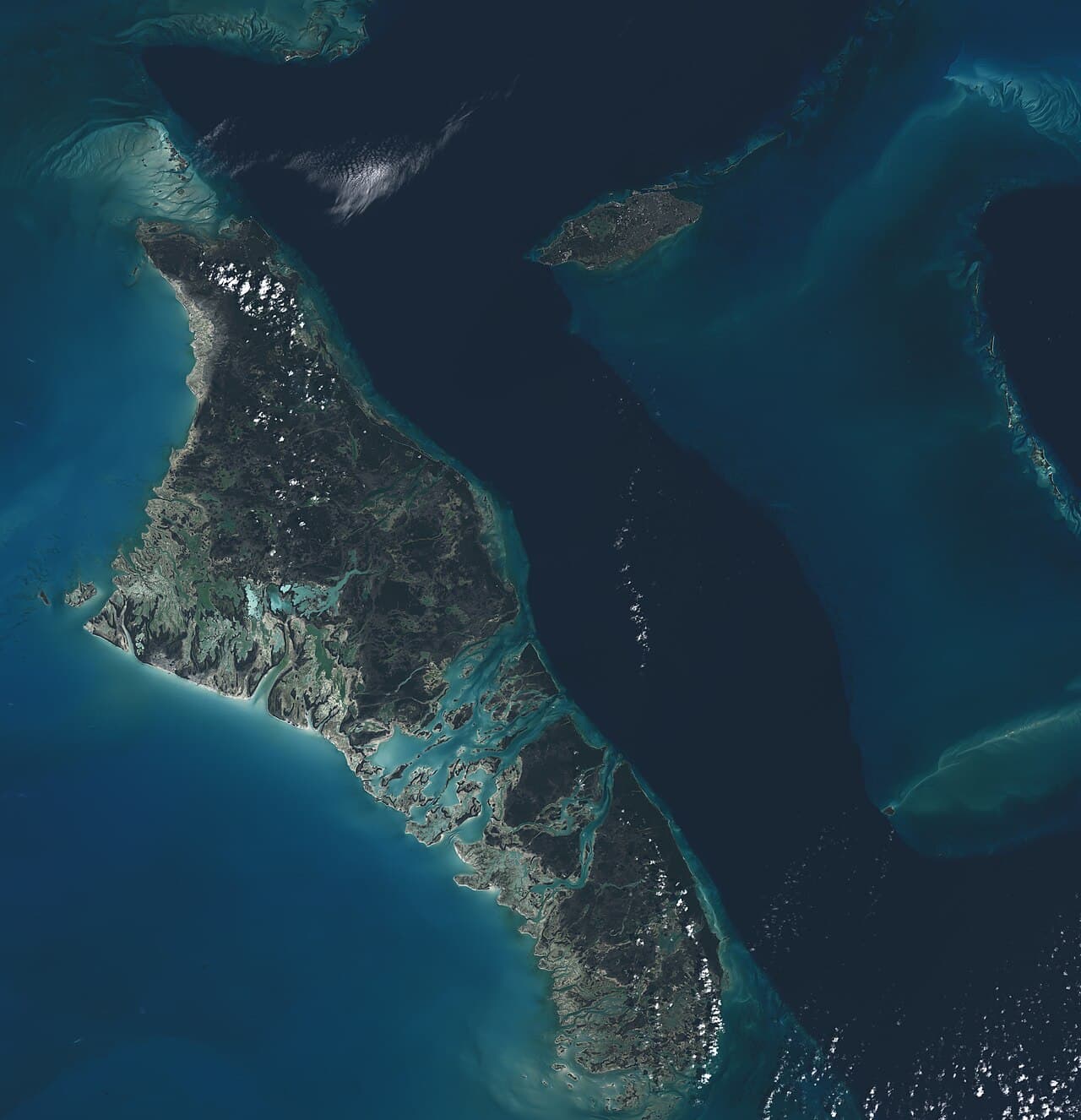
[ move across the map ]
Grand Bahama and Abaco lie further north, off this frame.
Andros
The largest island, and the largest single stretch of pine forest, wetland and barrier reef in the country. Its interior is a maze of blue holes and tidal creeks that has never been fully surveyed. Where the most is left to protect, and where protecting it counts for the most.
Andros alone is larger than the rest of the inhabited Bahamas combined, yet holds a fraction of the population, which is a large part of why its pine forest and barrier reef remain this intact. Its blue holes connect to the sea through underwater cave systems that cave divers are still mapping today.
Grand Bahama
Hardest hit by Dorian, which stalled overhead for two days and drove salt water miles inland. Pine and mangrove recovery here is slow and uncertain, and it is the clearest test anywhere in the country of whether restoration can outpace loss.
Lucayan National Park protects one of the last stands of mature pine left on the island, alongside Gold Rock Creek's mangrove, both inside the same storm path Dorian took in 2019. What regrows here over the next decade is the clearest public record anywhere in the country of whether active restoration actually beats simply waiting.
Abaco
Mangrove creeks and reef flats that shelter young fish and conch, including the Marls, one of the largest mangrove wetlands in the region. Nurseries for the wider Bahamian fishery, and still recovering from the same storm.
A bonefish is worth far more to a fishing guide's livelihood swimming free through the Marls than it has ever been worth caught, which makes this water as much an economic case for protection as an ecological one.