A forest that grows almost nowhere else.
- Habitat
- Land
- Country
- The Bahamas
- Key figure
- 77% of Grand Bahama's forest damaged, 2019
- Source
- Bahamas Forestry Unit
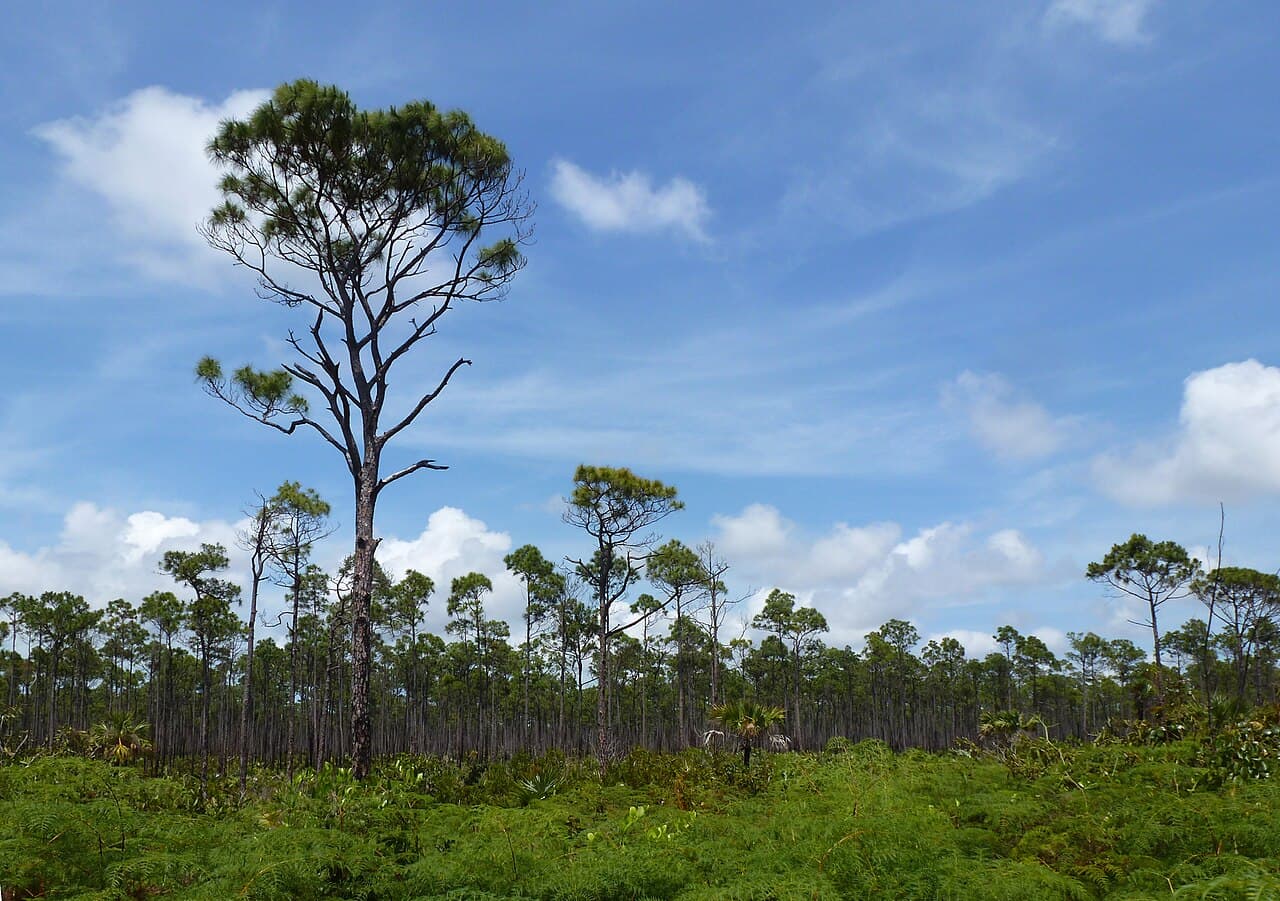
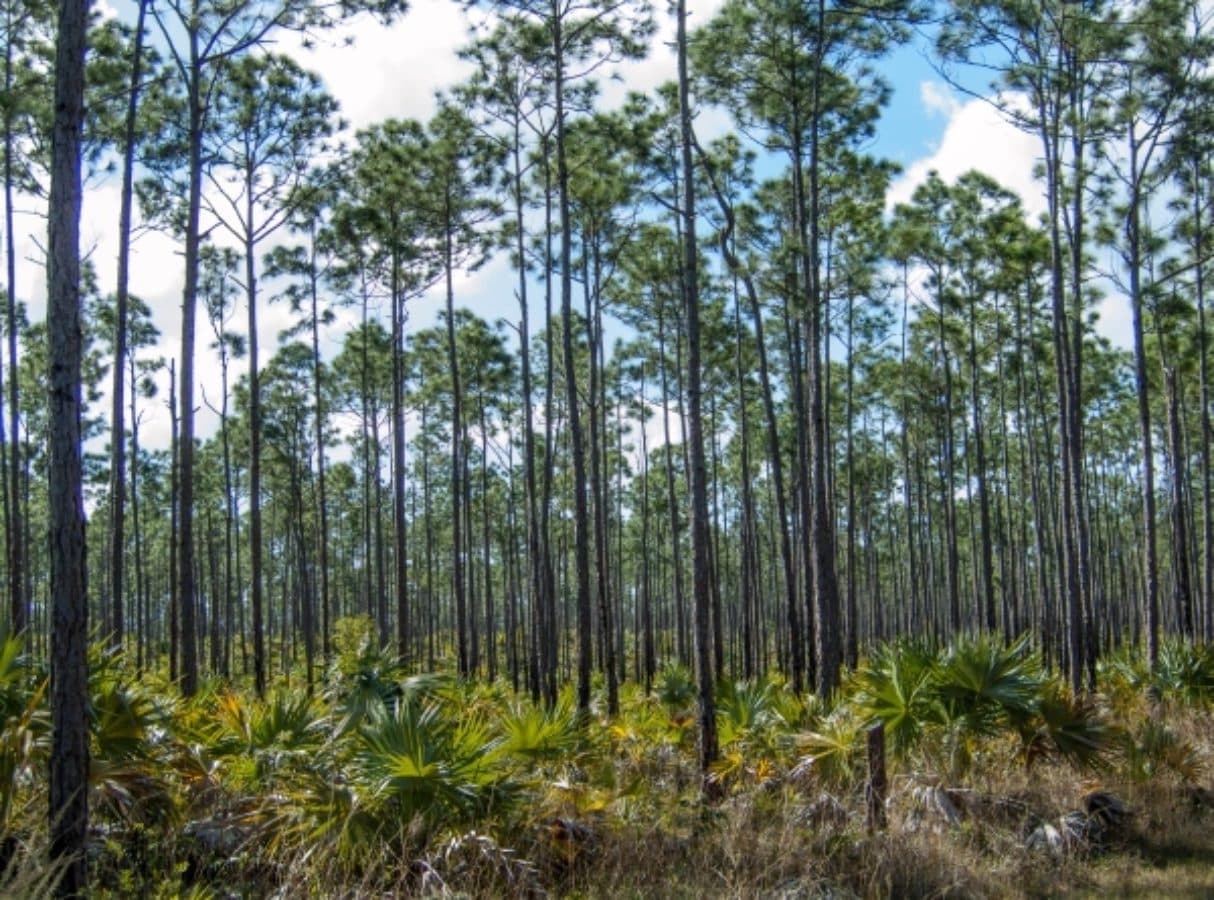
The northern islands carry the Bahamian pine, Pinus caribaea var. bahamensis, a variety that grows on Grand Bahama, Abaco, Andros and New Providence, and in the Turks and Caicos, and nowhere else on Earth. It is a tall, slender tree that grows from thin limestone soil, standing over an understory of thatch palm and palmetto.
Much of it was cut in the last century and came back as even-aged stands. Then Dorian damaged three quarters of Grand Bahama's forest in 2019, and the salt water pushed inland by the surge killed pine outright, well beyond the reach of the wind. Ground like that does not simply grow back. Our first land work aims to replant cleared and storm-battered stands, and to clear the invasive growth choking what remains, so young pines get the light and room they need.
The forest works above ground and below it. The pine holds the freshwater beneath it, and when a storm surge pushes salt water inland, it reaches the roots, which is why Dorian killed pine well beyond the reach of the wind. Protecting this forest means protecting the groundwater it stands on as well as the trees.
This forest holds species found almost nowhere else. On Abaco, the Bahama parrot nests mostly underground, in natural limestone holes in the pine forest floor, the only parrot in the Americas known to do so. That makes it as vulnerable as the forest floor it depends on.
- of Grand Bahama's forest damaged in 2019
77%
of Grand Bahama's forest damaged in 2019
Bahamas Forestry Unit
- of the remaining Bahama Warblers live on Abaco; the bird may now be gone from Grand Bahama
95%
of the remaining Bahama Warblers live on Abaco; the bird may now be gone from Grand Bahama
BirdLife International
What threatens it
Storm surge
Salt water pushed inland by a hurricane kills pine from the roots, well beyond the reach of the wind. On Grand Bahama after Dorian, forest that looked standing died over the following months.
A thinning water supply
The pine stands on the fresh water many islanders drink. After Dorian, 40% of Grand Bahama's water supply turned brackish, and a model of Andros found that less rain soaking in could shrink the fresh water by up to 19%.
Pests and fire
An insect pest has killed almost all mature pine in the Turks and Caicos. Fires that come too often, and clearing for development, keep stands from ever reaching old age.
Losing the birds with the trees
The Bahama warbler and the Abaco parrot both depend on mature pine. Lose the forest and both go with it.
Species that depend on it
Each has its own page, with its figures, what threatens it and what nobody knows yet.
- Vulnerable (IUCN)Read more
Bahamian pine
Pinus caribaea var. bahamensis
The tree the northern islands stand on.
The Bahamian pine is the only pine native to The Bahamas and the Turks and Caicos. The parrot nests beneath it, the warbler feeds on it, and the fresh water many islanders drink sits in the rock below it.
- Near Threatened (species, IUCN)Read more
Bahama parrot
Amazona leucocephala bahamensis
A parrot that nests underground.
On Abaco, the Bahama parrot raises its young below the forest floor, in natural holes worn into the limestone under the pine. Researchers describe it as the only parrot in the Americas known to nest this way.
- Endangered (IUCN, since 2020)Read more
Bahama warbler
Setophaga flavescens
A bird that lives on two islands, and may now live on one.
The Bahama warbler is found only on Abaco and Grand Bahama, working its way along the trunks of Caribbean pine. After Hurricane Dorian, a 2023 study found it may now be gone from Grand Bahama.
- Andros subspecies Endangered (IUCN)Read more
Northern Bahamian rock iguana
Cyclura cychlura
An iguana that only lives here.
The Northern Bahamian rock iguana lives on Andros and on a scatter of small cays in the Exumas, in three forms. The largest, the Andros iguana, is listed as Endangered.
Where to see it
The islands where this habitat matters most to our aims, each with what is known and what is not.
- Open the island
Grand Bahama, after the storm.
Hurricane Dorian struck this island in 2019. It is the best-documented place in the country to see what a storm does to mangroves, forest and fresh water, and what putting them back takes.
- Open the island
Abaco, nurseries under strain.
Mangrove creeks and reef flats that shelter young fish and conch, including the Marls, one of the largest mangrove wetlands in the region. The same storm that struck Grand Bahama in 2019 struck here, and Abaco took most of the cost.
- Open the island
Andros, where the water sits.
The largest island in the country, with one of its largest stretches of pine forest, wetland and reef. Most of what is known about its fresh water comes from older studies, and we say so where it matters.
What we aim to do here
Restore
Replant native Caribbean pine and mangrove where storms and clearing have stripped the land bare, starting with the ground that recovers slowest on its own. Putting seedlings in is the easy half. The harder half is the years of watching that decide whether a seedling ever becomes a tree.
Protect
Work alongside the government and national conservation bodies to keep the most irreplaceable habitat off-limits to development for good. A line on a map is worth only the wardens, boats and surveys behind it, so we fund the holding of a protected area as well as the drawing of it.
What nobody knows yet
- How much of Grand Bahama's damaged pine is growing back on its own.
- How the fresh water under Andros has changed in recent years. We found no recent published measurements.
- Whether any Bahama warblers survive on Grand Bahama.
Sources
- 1Bahamas National Trust, State of the Environment: Post-Dorian Report
- 2Imig et al. (2024), Hydrology and Earth System Sciences: fresh water on Grand Bahama after Dorian
- 3Royal Botanic Garden Edinburgh: threatened conifers, Pinus caribaea var. bahamensis
- 4BirdLife International: Bahama warbler factsheet