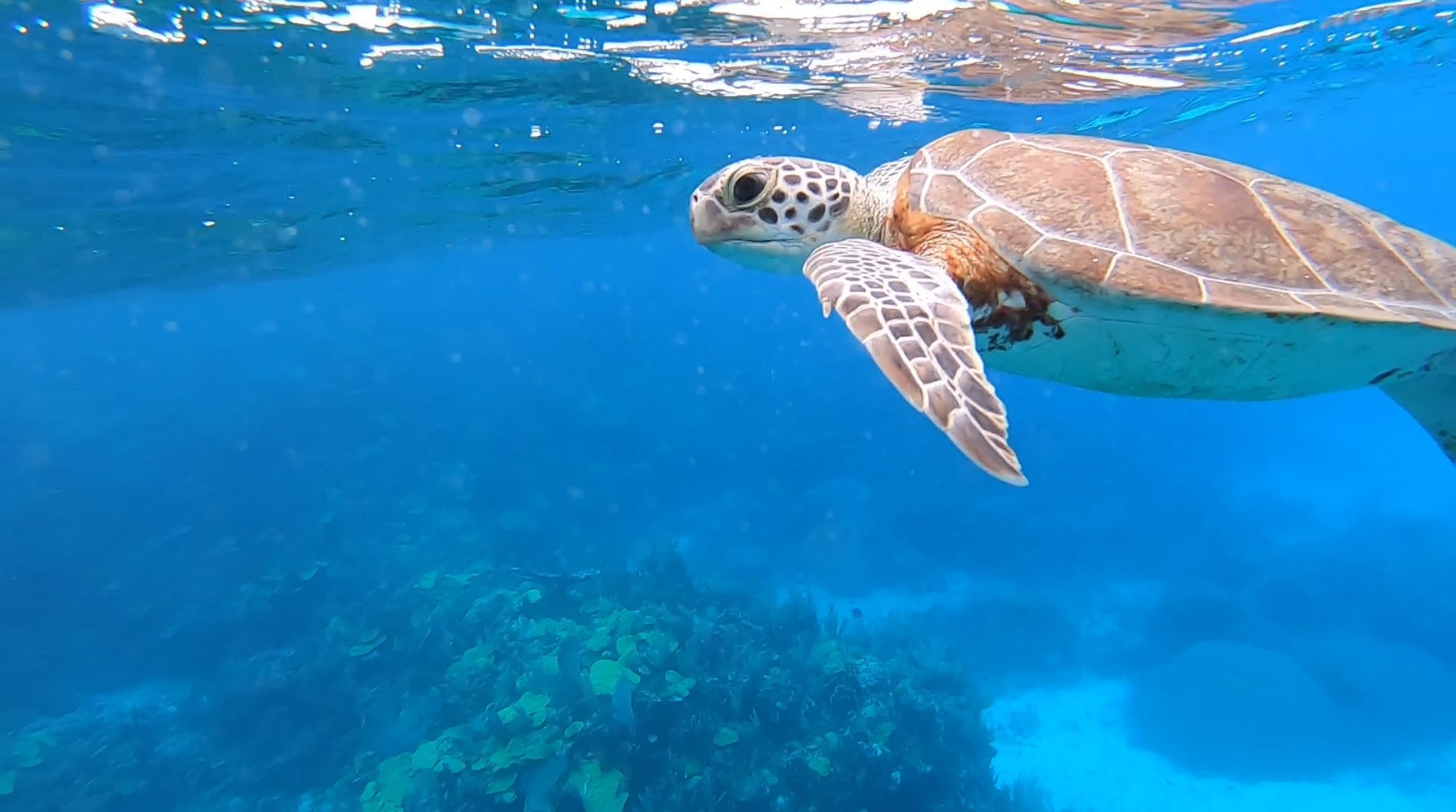
Reefs. A living seawall, 190 miles long.
The Andros Barrier Reef is the third-largest on Earth, running almost the length of the island before the seabed falls away into the Tongue of the Ocean, a trench more than a mile deep. It is a nursery, a storm barrier and a livelihood at once. The coral takes the energy out of a swell long before it reaches a settlement, and the fish sheltering inside it are the fish that end up on the table.
Across the Caribbean, reefs have lost most of their coral cover in a single lifetime, to warming water, to disease, and to the loss of the grazers that keep algae off the rock. We survey reef health across the shallows at fixed sites on a fixed schedule, publish what we find, and back the Bahamian divers and fishers who are already protecting them.
A reef needs its grazers as much as it needs its coral. Parrotfish and sea urchins keep algae cropped short enough that coral larvae can actually settle and take hold; where overfishing has stripped a reef of its grazers, even coral that survives a bleaching event can still lose the fight to algae within a few years.
Once a year, Nassau grouper gather by the thousand at a handful of reef drop-offs to spawn, all on the same few nights around a winter full moon. Those aggregations are easy to find and easy to net out entirely in a single season, which is exactly what happened to most of the Caribbean's; protecting the handful of sites that still hold one is protecting the species' entire future at once, not just a single reef.
190 miles long, 160+ species of fish and coral / Bahamas National Trust
- of the Andros Barrier Reef, third-largest on Earth
190miles
of the Andros Barrier Reef, third-largest on Earth
Bahamas National Trust
- species of fish and coral on the reef
160+
species of fish and coral on the reef
Bahamas National Trust
What we are doing here.
Study
Survey reef and seagrass health at fixed sites on a fixed schedule, so one year can honestly be compared with the next. We publish what we find openly, including the results that are inconvenient for us, so the science stays a shared tool rather than a private asset.
Partner
Hire and train Bahamians for the fieldwork, and back the fishers, divers and foresters already stewarding these waters every day. They carry knowledge no visiting organization arrives with, and the standing to make protection hold in the settlements it affects.