How the water works.
Under many Bahamian islands, the only fresh water is a thin layer floating on the sea, inside the rock. The pine above it, the mangrove around it and the storms that reach it are one system. Scroll through it.
Step 01 of 06 · illustration not to scale
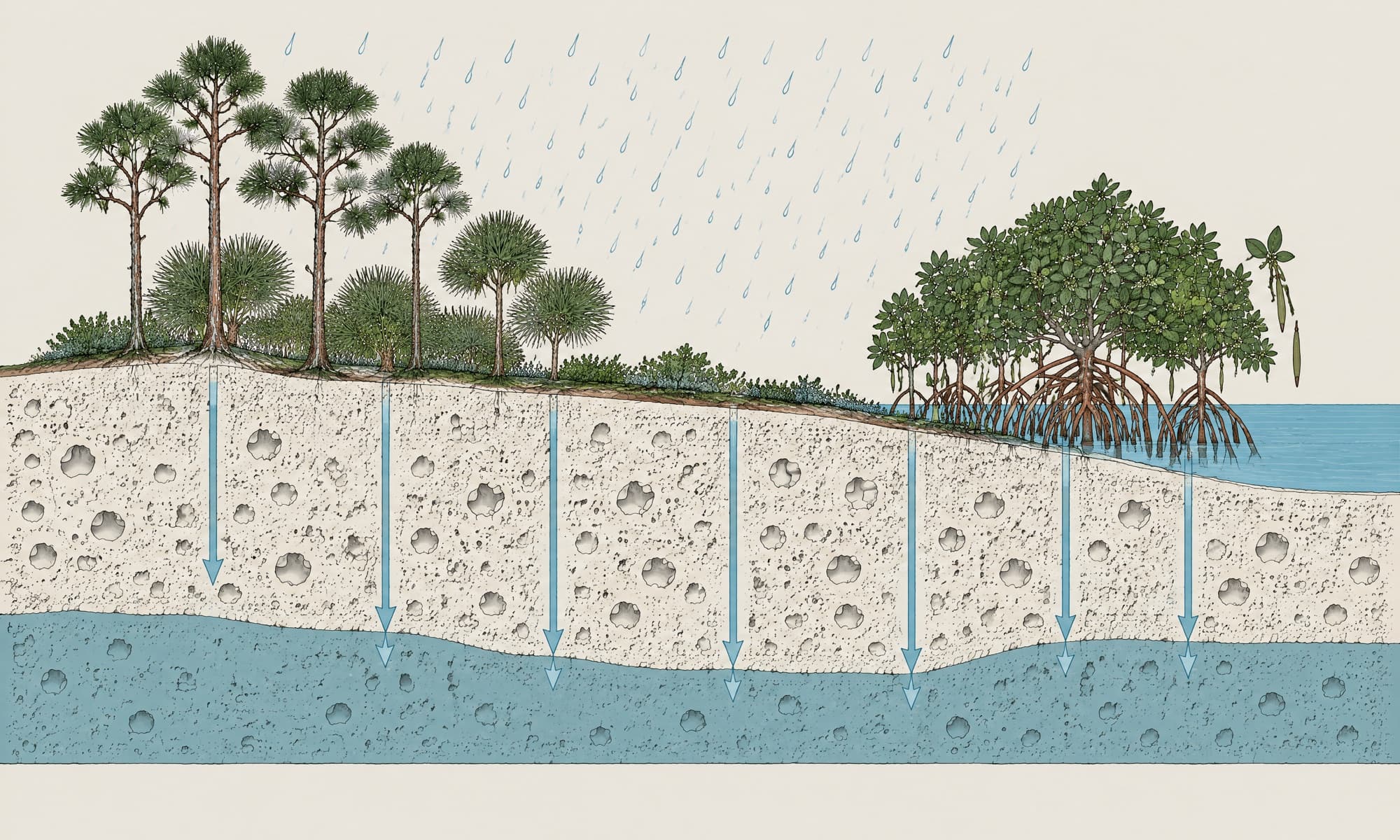
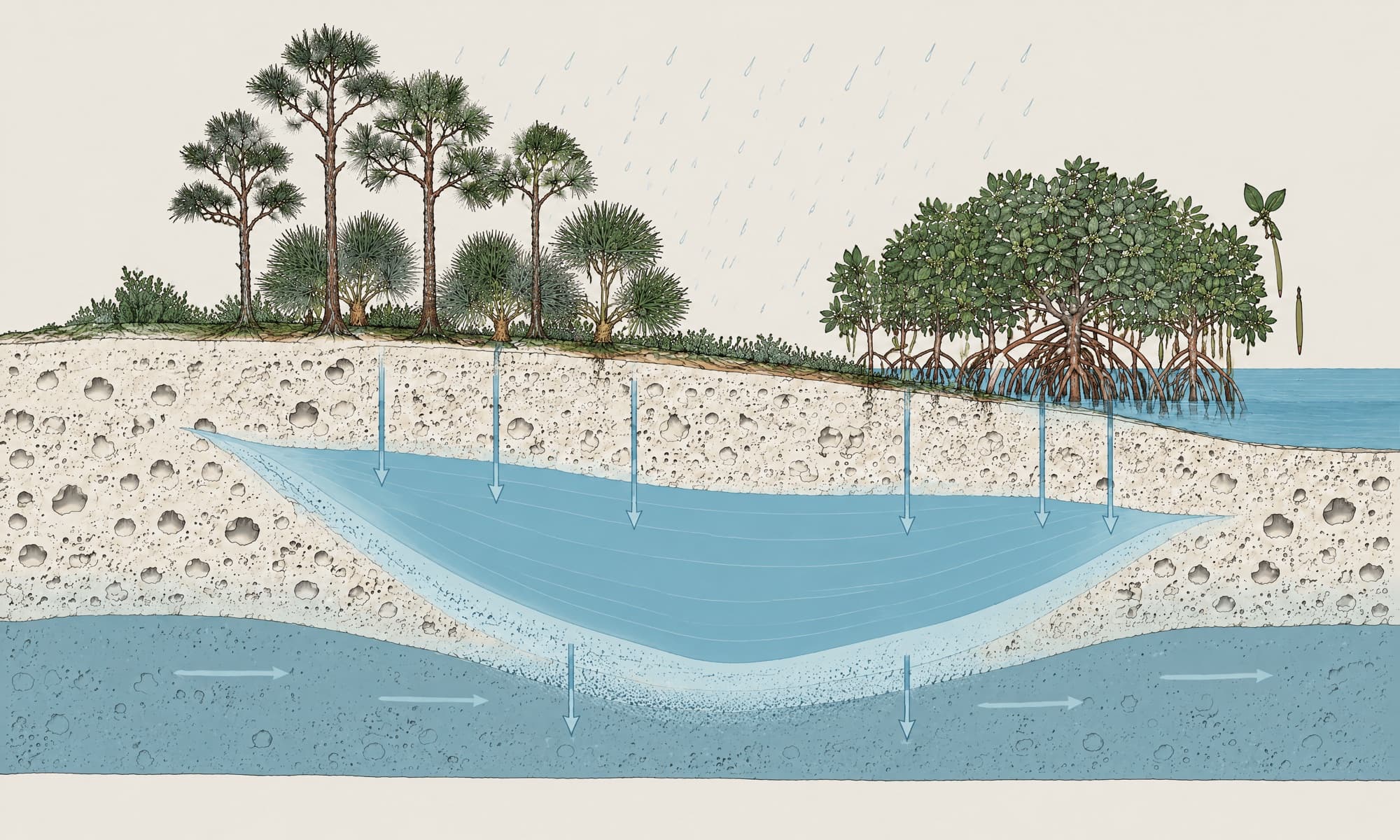
It starts as rain.
Most Bahamian islands have no rivers to speak of. Their fresh water starts as rain, which soaks straight down through the porous limestone instead of running off.Imig et al. 2024
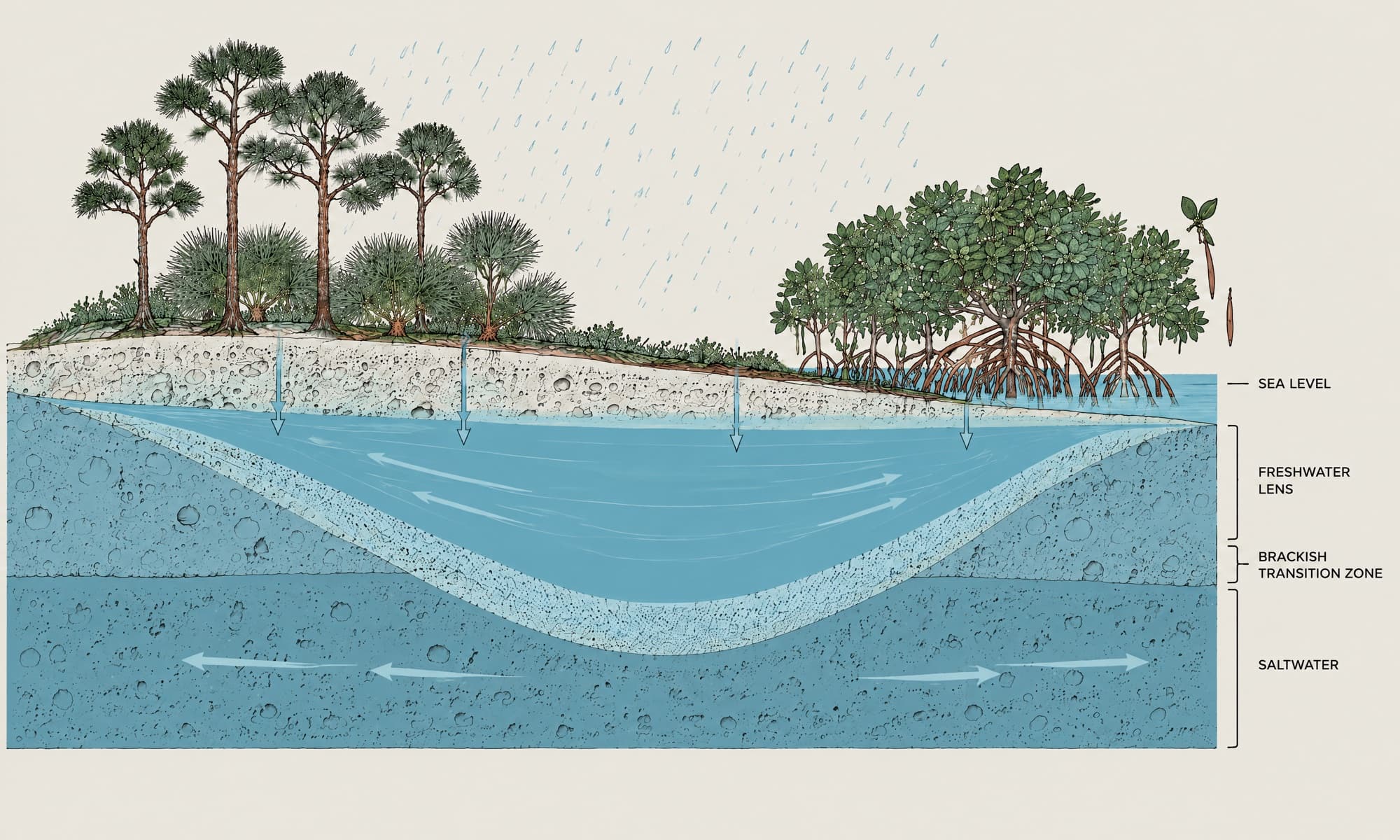
Fresh water floats.
Fresh water is lighter than seawater, so inside the rock it collects as a thin lens floating on the salt water beneath. For every metre the fresh water stands above sea level, it reaches roughly forty metres below. This is the water many islanders drink.Ghyben–Herzberg relation
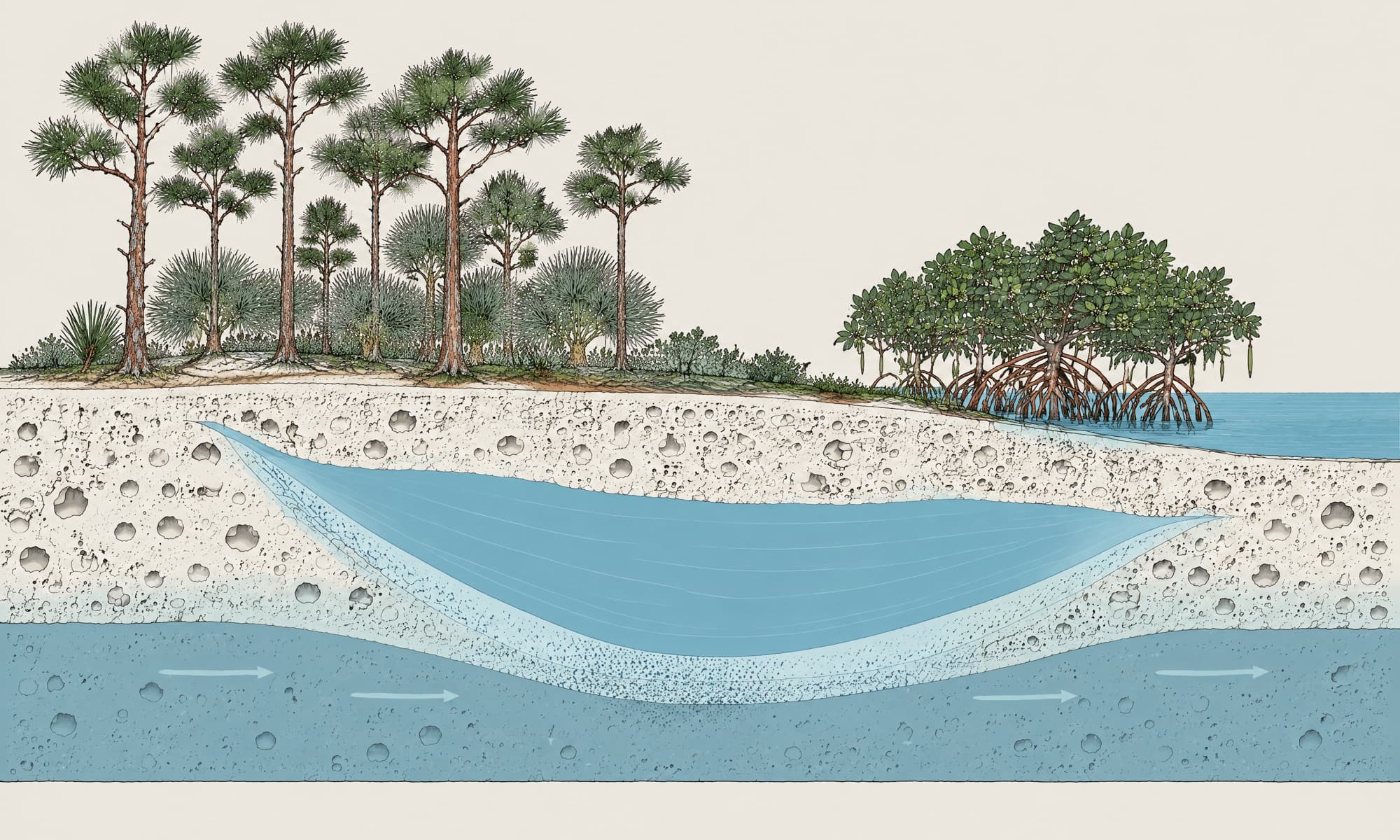
The forest keeps the rain coming in.
Pine forest and wetland hold the ground open for rain to soak in. A 2015 model of Andros found that less rain reaching the lens could shrink it by up to 19%, against up to 5% from sea-level rise. Trees also draw water out, so researchers say the balance needs studying island by island.HESS 2015, Andros model
The mangrove stands at the edge.
Mangroves take the first push of a storm surge. Modelling from other Caribbean islands suggests they cut flooding behind them; we found no measurement for The Bahamas. Hurricane Dorian damaged 91.2 of Grand Bahama's 123.6 square kilometres of mangrove.Lewis et al. 2025; Soanes et al. 2023
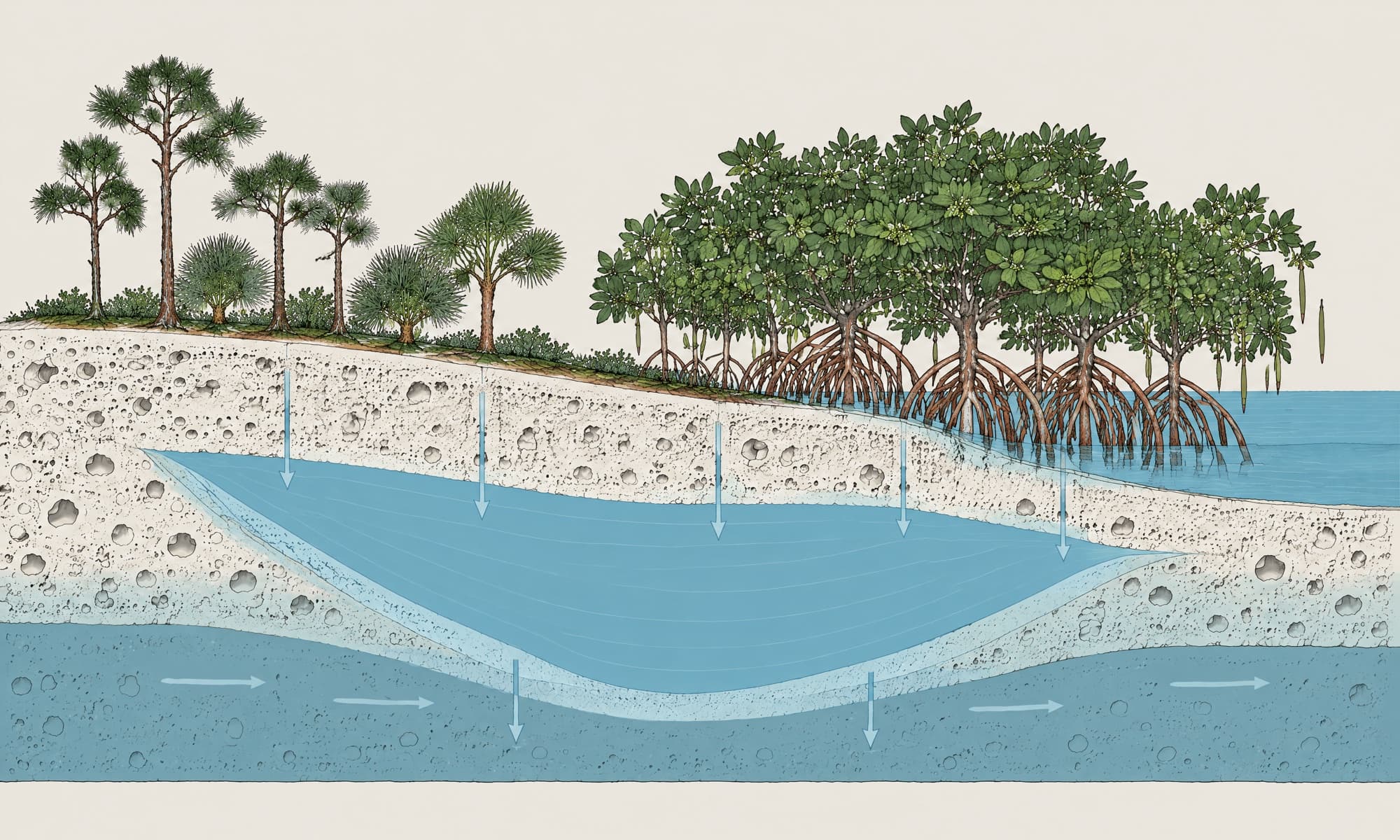
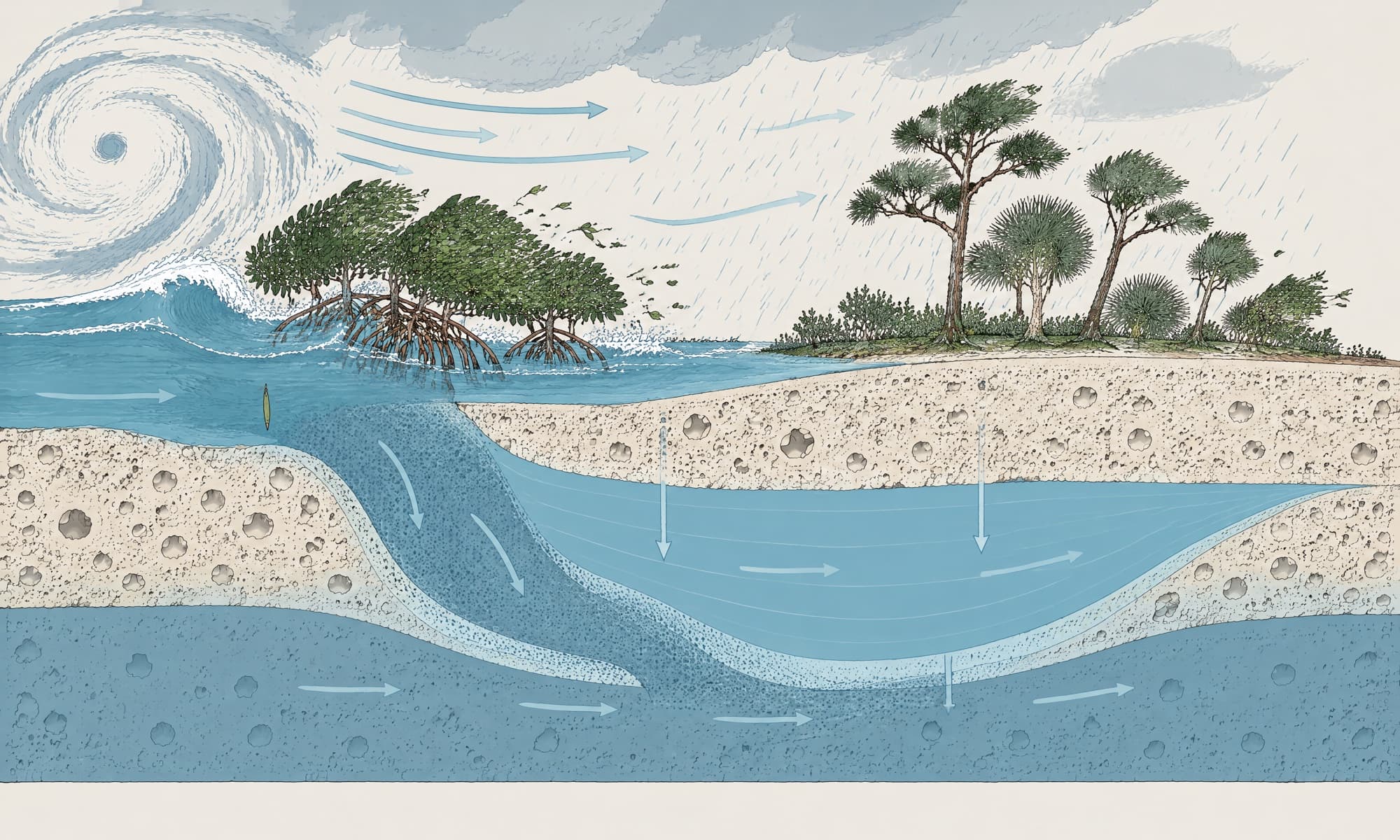
Then the sea comes over.
A surge floods the land, and salt water sinks down through the rock into the fresh water below. After Dorian in 2019, 40% of Grand Bahama's water supply turned brackish, and about 30% of residents still lacked drinkable water.Imig et al. 2024
It takes years to clear.
Only rain flushes the salt back out, and it does so slowly. Researchers estimate natural recovery on Grand Bahama could take around twenty years. Salinity in the main wellfields has fallen since the storm, but has not yet fully recovered.Imig et al. 2024; IJBS 2023
- of Grand Bahama's water supply turned brackish after Dorian
40%
of Grand Bahama's water supply turned brackish after Dorian
Imig et al. 2024
- for the fresh water to recover naturally, by researchers' estimate
~20 yrs
for the fresh water to recover naturally, by researchers' estimate
Imig et al. 2024
- of the Andros lens that less recharge could cost, in a 2015 model
19%
of the Andros lens that less recharge could cost, in a 2015 model
HESS 2015
What replanting has taught
From the community mangrove replanting on Grand Bahama after Dorian: more than 100,000 mangroves planted by the end of 2024.
Seedlings beat bare seeds
After almost three years, 54% of nursery-grown mangrove seedlings were alive, against 12% of seeds planted straight into the mud. Seedlings cost more time and money to raise.
The place matters most
The same planting did very differently from site to site, from none surviving to 83%.
Nature will not fix this alone
The stunted mangroves that died back do not produce seeds, and no new mangroves took root in unplanted plots over three years.
Lewis et al. 2025
What nobody knows yet
- How the fresh water under Andros and Abaco has changed in the last few years. We found no recent published measurements for either.
- Whether more pine forest helps or hurts the water layer on a given island.
- How much Bahamian mangroves cut flood damage in measured terms.
Sources
- 1Imig et al. (2024), Hydrology and Earth System Sciences: restoring groundwater and forest on Grand Bahama after Hurricane Dorian
- 2Hydrology and Earth System Sciences (2015): modelling how a freshwater lens responds to climate stressors, using Andros
- 3International Journal of Bahamian Studies (2023): Grand Bahama after Dorian, fresh water in two primary wellfields
- 4Lewis et al. (2025), Wetlands Ecology and Management: mangrove restoration after a catastrophic hurricane in The Bahamas
- 5Soanes et al. (2023): nature-based solutions for storm surge and erosion in Anguilla
- 6Bahamas National Trust, State of the Environment: Post-Dorian Report
- 7The Ghyben–Herzberg relation (fresh water floating on salt water)
The drawing is not to scale. This page has not yet been reviewed by a Bahamian scientist; if you see something wrong, write to hello@veritasylva.org.