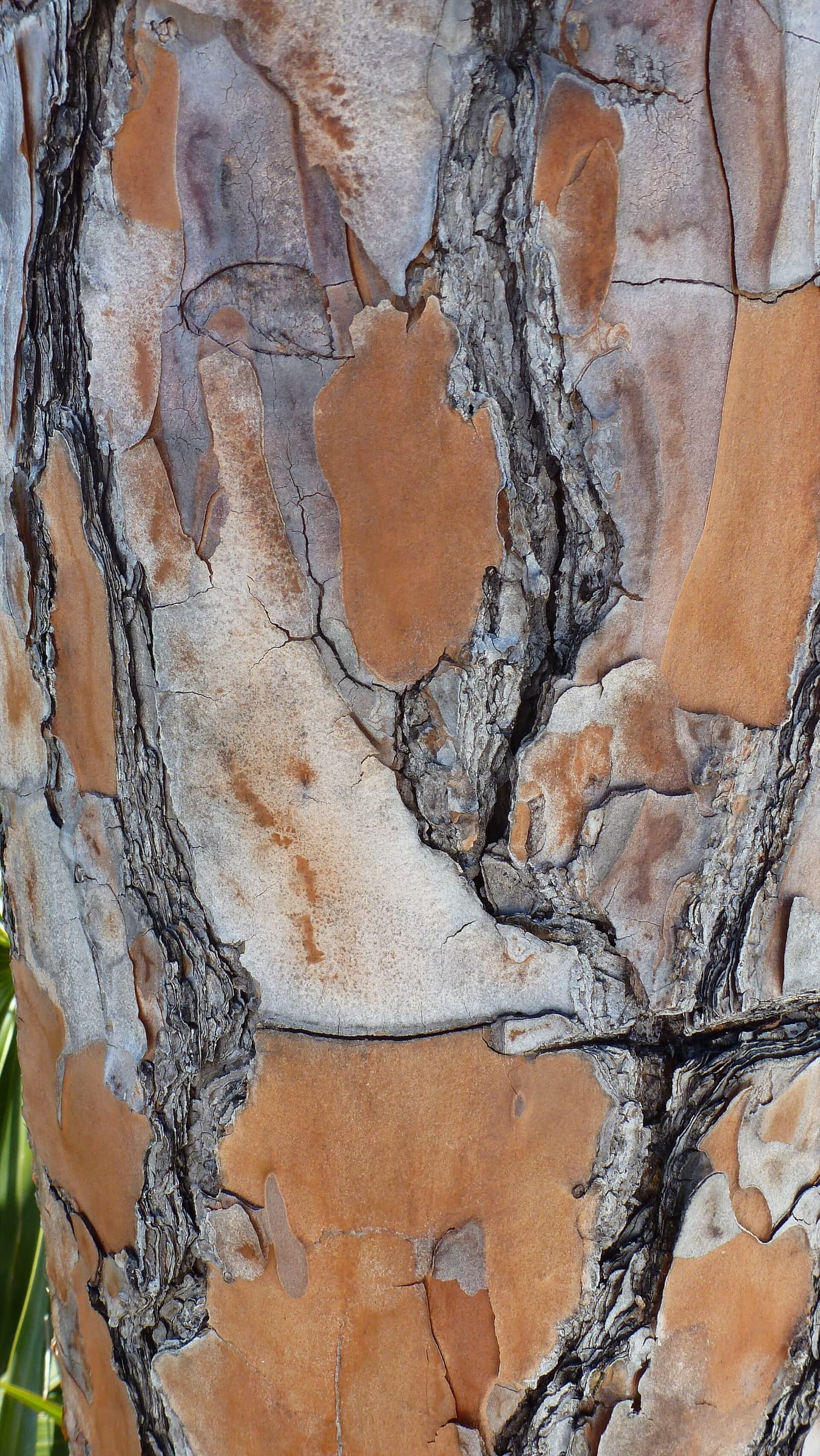
The tree the northern islands stand on.
Bahamian pine bark, Lucayan National Park. Photo: Mike Gifford, CC BY-SA 2.0, via Wikimedia Commons
- Species
- Bahamian pine
- Scientific name
- Pinus caribaea var. bahamensis
- Status
- Vulnerable (IUCN)
- Where
- Grand Bahama, Abaco, Andros, New Providence; the Turks and Caicos
The Bahamian pine is the only pine native to The Bahamas and the Turks and Caicos. The parrot nests beneath it, the warbler feeds on it, and the fresh water many islanders drink sits in the rock below it.
Much of the forest was logged in the last century and grew back as even-aged stands. According to the Royal Botanic Garden Edinburgh, old-growth forest now survives only on Little Abaco, on South Andros and in the Turks and Caicos.
Hurricane Dorian damaged 77% of Grand Bahama's forest in 2019. In the Turks and Caicos, almost all mature trees have been reported dead after an insect pest attack. The variety is listed as Vulnerable.
Habitat: Pine forest- of Grand Bahama's forest damaged by Hurricane Dorian
77%
of Grand Bahama's forest damaged by Hurricane Dorian
Bahamas National Trust
- places where old-growth forest survives: Little Abaco, South Andros, Turks and Caicos
3
places where old-growth forest survives: Little Abaco, South Andros, Turks and Caicos
Royal Botanic Garden Edinburgh
What threatens it
Storm surge
Salt water pushed inland kills pine from the roots, well beyond the reach of the wind.
Pests
An insect pest has killed almost all mature trees in the Turks and Caicos.
Clearing and fire
Development and fires that come too often keep stands from ever reaching old age.
What we aim to do
Back the replanting of storm-killed stands, starting where the ground will not recover alone.
What nobody knows yet
How much of Grand Bahama's damaged pine is growing back on its own.
Sources
- 1Royal Botanic Garden Edinburgh: threatened conifers, Pinus caribaea var. bahamensis
- 2Bahamas National Trust, Post-Dorian Report
Figures are reported as the sources give them. This page has not yet been reviewed by a Bahamian scientist. If you see something wrong, write to hello@veritasylva.org and we will correct it.